Roots 'n' Shoots

Why is RnS Moving to whiskerflowers.wordpress.com?

Google had brought out an algorithm update in May 2017. With previous updates like Panda or Penguin, Mr G had penalized blogs or websites with low quality content and those more focused on aggressive adverts (including multiple ads or pop-up ads in articles). However, many blogs/websites that weren't shady got penalized beyond recovery too and a lot of people lost their income. The May 2017 update has had wide-scale effect on blogs and websites, but without any explanation from Mr G as to why or what it does. RnS has been hit by it too and hard. RnS organic search stats (i.e. users from Google) have dropped by 75% since. Even though RnS is not a source of income, I tried to figure out why RnS is being culled. It seems that it doesn't really have anything to do with RnS per se, but likely because RnS is FREE and not paying for page ranking (via AdWords or Ad Ranking). Now it is likely being aggressively shoved to lower page rankings to accommodate the paid ads.

I cannot rely on Mr G anymore to get RnS' content where it is needed. So I am busy moving RnS to Wordpress where you can find me as Whisker Flowers @ https://whiskerflowers.wordpress.com/

I am also imposing 301 redirects from already moved posts and pages!

- The Shroom - (AKA Whisker Flowers)

Monday, 18 August 2014

Roots 'n' Shoots Birthday (Blogiversary) Post #3


It has been three years since the start of Roots 'n' Shoots in August 2011 - WOW - that is about as long as a undergraduate degree in Science or longer than most peoples' relationships ... LOL! Anyways, this is the annual B-day post (apparently a blog's birthday is a blogiversary! At least B-day works either way!). This is a post where I allow myself to go off on a tangent, write about crazy unrelated stuff and if it ends up being an entire post without anything informative, then... *meh*

First off I would like to send a shout-out to Blooming Blogs! I love the new magazine format for blog display and that it updates automatically when I post - very convenient which means I can spend more time on post writing than updating third-party sites :)  Also Blooming Blogs has helped Roots 'n' Shoots grow a lot more than my first sign-up to a social garden site, Blotanical.

I have booted Blotanical from my site since they had decided to abandon their users and not respond to their problems - for instance - Google feedburner stopped working for my blog back in 2012 (as it did for most other Blogs as well). I did not notice until 6 months later when my Blotanical profile wasn't updating. I tried all kinds of ways to re-activate my account there (becuz they shut you down after 3 months if no posts update) but to no avail... I emailed Blotanical sometime last year (exactly on 28 June 2013!) and they did not respond. So after 6 months of not replying I removed them from Roots 'n' Shoots considering that they have forgotten to care about their members, who are the foundations of any blog or website! I have had more visitors and support from Blooming Blogs than Blotanical ever did! Thanx Blooming Blogs!

Tiny time capsules
Rose moss seeds

OK, so that is off my chest, now second rant - or not really a rant, more like an observation. Many other gardening blogs become ghosts round about their 3-4 year mark, mostly due to their writers suffering from what is known as "Blogger Burnout". I have seen this happen to gardening blog the same age as mine! Blogger Burnout occurs when blogging is no longer a source of relaxation or entertainment and merely becomes another chore on your to-do list. This is quite sad as most of these writers never take up their blogs again, and those who rarely do find that by that time they return to their blogs that all of their readers have left as well... I really do feel for these fellow bloggers, since maintaining a blog is a lot of work;

(1) decide on what to write about [this is not always readily apparent!],
(2) research, research and more research,
(3) get some good quality, free photos or diagrams [Hah! As if!] - else take/make your own,
(4) *wait for screen loading*
(5) write the post,
(6) edit the post [fix all those blatantly obvious grammar/spelling errors you missed the first time],
(7) get the pictures in the correct format and size [this can be the most time robbing stage, but it needs to be done and I will stay strong!],
(8) upload pictures,
(9) *more loading* - *sigh*
(10) add any attributions or references,
(11) double check links and
(12) publish! [Woo-pee! Made it! Now over-zealously check blog every 5 minutes to see who is reading the new material by hitting the refresh button multiple times]...  ;-P

Here is my hypothesis to the cause of Blogger Burnout: blogging too much!!! Yes, you won't think that it is a bad thing to do so many posts as it generates traffic to your blog, but posting too often leads to writer fatigue, inspiration loss and de-motivation... and sadly the associated blog becomes a ghost...

This is one of the reasons why Roots 'n' Shoots features at most 2 posts every month, which is usually 1 Profile post (How to Grow) and 1 Extra post (Different Garden Topics). I am very committed to these two posts each month and additional posts do creep in when something exciting happens (such as the Earthquake earlier this month!) then it goes over the 2 post limit. The 2 post limit does not only keep me sane and prevents all my time going into blogging, but keeps me inspired and motivated to write.

Yes I have my Blogger Blues, where I find myself staring at the screen not sure where to start or what to write, but I tediously manage something informative. Then before I know it I have found my writing mo-jo and I am slamming posts out on the keyboard like no body's business! This is when I have to be well disciplined not to post them all in one go cause I think they're sooo cool, but to put them away and schedule them to come out every 2 weeks for the next few months. This means Roots 'n' Shoots is pumping out informative, well written (hopefully; seeing that I got all those blatantly obvious mistakes) and picture jammed posts while I can get on with my day job and with life in general  :) So, I am sure that my Sanity-Saving-Post-Scheduling-Method shall exile any Blogger Burnout from spoiling Roots 'n' Shoots in the future... I found a lovely post relating to the topic and agree with many of the items listed there. Hopefully Roots 'n' Shoots will also see its 10 year mark and beyond by virtue of being a Generous Blogger.

Honey bee on Garden Heliotrope

Staying with blogging; here comes the ranting section specifically about the Blogger format that Google developed but stopped improving. *Sigh* I sometimes admire at Wordpress sites or 'own' domain websites and see all the cool functionality there and I think to myself, now why did I not do that instead of a blog? Don't get me wrong - blogging, post writing and sharing my discoveries I really enjoy, but I would like my blog to be a bit more pretty and functional. For instance, I love the Wordpress layouts and themes, they always seem so professional and I have tried on various occasions to get a similar effect on Blogger - but I end up with a huge mess and colours/fonts clash the heck out of one another! So Roots 'n' Shoots has its original colour/font scheme since its initiation as this is the most eye pleasing and easy reading combination that I also like... Bah! Then there is the layout problems, especially INDEXING!!! I am OCD and fanatic about filing: Everything needs to be neatly organised and filed under topics for easy reference and time efficiency (reason why I like Pinterest!), but that 'Blog Archive' widget thing on the left hand side does not represent this in the least. It is the most un-user-friendly and tedious device ever! Go ahead, try it! Grrrr.. So my attempt at making it easier for you guys was to place the Index & Info Page at the top, which has resolved some of my filing issues as well given all the restrictions of Blogger... If any of you fellow Bloggers have come up with another solution, please share! J

Anyways, something very exiting is that my research project is more aligned with my vegetable gardening endeavours than before, which means I will be able to maximise my research for both my project and my blog - Kazam!, which means working smarter and not harder. Bwah ha ha!

I have noticed the large appreciation for my 'Sustainable, Productive and Economical Veg Garden' related blog post and shall be writing more on that topic in the near future. I want to emphasise the need to grow your vegetables economically, so that you can save money (even make money, by selling produce maybe?) by having one and that this is not an ornamental garden where heaps of money is thrown at aesthetic appeal - it is a working home unit and I will share with you how to maximise production and minimise costs in a well managed vegetable garden. Of course is should be neat, tidy and pretty, but that is all achievable on a shoestring budget and some creative savvy! (Like, did you notice my shroom rock that I painted up top? - Free garden ornaments seeing that I had the paint on hand anyways... tee hee!).

LOL!
My attempt at a Garfield inspired bird deterrent painted rock!

All in all Roots 'n' Shoots is here to stay and I am moving my gardening practices into an even more organic and sustainable direction - so, keep on dropping by for informative how-to's, creative projects and join me on my vegetable gardening journey!

BTW - I have expanded my 'social networking' (me being impaired in that area and such)... So, I have set up several accounts. Most function as news reels for blog posts and will make it easier for those of you already on those platforms to get my updates there, this would be: My Twitter Account. Others I am more active on an will include additional garden related info beyond that on Roots 'n' Shoots such as MyFolia Account and Pinterest Boards. You can also sign up directly as a follower to my blog given you already have a Google, Yahoo or Twitter account. If those don't do it for you; I have a RSS Feed with FeedCAT.net which allows email subscriptions and accommodates other feed readers. My ProjectNoah account is purely for wildlife spottings.


Please feel free to subscribe to my blog as a follower or to a feed reader/social networking site:

Direct Blog Subscription: Check out my Blog Follower or Follow Posts Your Way! widgets (left hand side at the top).
RSS Feed: Feed Reader at FeedCAT.net
Email: Use the Follow Posts Your Way! widget with FeedCAT.net email subscription (left hand side at the top).

Twitter Account: https://twitter.com/The__Shroom
Pinterest Account: http://www.pinterest.com/Roots_n_Shoots/
MyFolia Account: http://myfolia.com/gardener/The_Shroom
Wildlife spottings in our area: My Project Noah account @ http://www.projectnoah.org/users/The%20Shroom

Also, if you like my content I have a myriad of ways to share them (below each post or page) with your friends and family. Else you can simply 'vote' for them using the reactions supplied at the end of the posts.


A last THANK YOU to all my readers, even though many of you don't comment or follow I can see your continuous presence and support on my blog stats! I would like to make a special mention of Dani @ Eco Footprint ~ South Africa for the shout out on her blog earlier this month; it was fully appreciated, thanx! Over at Dani's you will find many ways to as well as tips and tricks on how to do off the grid living!

Thank you to all my readers once again, as I enjoy posting informative articles for your delight!


P.S: On the 24th of August is World Kitchen Garden Day! Head over to Kitchen Garden International to check out some ideas on how to celebrate this day!

World Kitchen Garden Day
© KGI.org

TTFN - Ta-Ta For Now!

The Shroom


Posts mentioned in the article:

Starting a Productive and Economical Vegetable Garden: vegetables worth growing


____________________________________________________________________________________
If you enjoy the content please share with fellow gardening enthusiasts via the various sharing buttons at the end of posts/pages! Else you can vote for posts through the Google reactions bar at the end of articles. To stay up to date I have provided several reader and social networking platforms with which to subscribe: Twitter, Pinterest, RSS Feed Reader or Email/Follow directly using the Blog Followers or Follow Your Way widget on the left hand side toolbar. Thank you for reading and please feel free to ask if questions arise - I appreciate comments and ideas too! J
____________________________________________________________________________________

Tuesday, 5 August 2014

Earthquake hits Central South Africa!


Libanon Mine of Sibanye
near Westonaria, South Africa
South East of Johannesburg in the Earthquake zone

At 12h44: Wow! We just had a tremor run though Roodepoort (near Johannesburg, Gauteng) at approximately 12h25! Seems that this isn't the first time that a tremors or earthquakes have struck. There have been a few in the past as well, this one was felt by some of my friends in Pretoria (South) as well and likely originated from an old mine shaft that collapsed, (maybe the Brixton one again, not sure!).

Updates to follow!

At 12h55, alright from the people coming in on this post (from my blog stats), it seems people felt this in:
Santon
Johannesburg
Pretoria
Centurion
Cape Town
East London
Germiston
Midrand
Durban
Benoni
Klerksdorp
Krugersdorp
Olifantsfontein
Berea
Randburg
Westville
Emalahleni
Boksburg

At 13h00: The reports are in!

Time of occurrence 12h22

Earthquake of 5.3 magnitude! (Amended to 5.5 by experts at a depth of 10 km)

Centered in Orkney, 120 km Southwest of Johannesburg! An area with many gold mines. At around 13h15 South African gold miners with head offices in Johannesburg and Sandton advised that they had felt the earthquake at their head offices but have so far received no reports of damage from their mines. 

Earthquakes and deep level mining does not bode well and I hope that no mine workers will be injured.

Seismometers measure earthquakes according to the Richter magnitude scale, which quantifies the amount of energy released by an earthquake - more specifically total moment energy.

Measuring at 5.3; today’s earthquake can be described as ‘Moderate’. It can cause damage to building with poor construction and everybody will feel its tremors. On a global scale, approximately 500-1500 of these earthquakes occur per year. Only earthquakes that reach above 7 cause great damage to buildings and are classified as Major (around 7) and Great (above 8). Earthquakes of magnitude 8 release an equatable amount of energy to 6 million tons of TNT!


Earthquake hits central South Africa
Google maps platform ©
Red marker: Earthquake origin at Orkney
Blue maker: Roodepoort, Gauteng

References:

Reuters Africa
3) International: USA Today

At 14h45: Can we expect aftershocks from this Earthquake event?

Seismogram

After some research the short answer is: YES.

Magnitude 5 (M5) earthquakes can generate aftershocks minutes after the initial event that can last for days. These will be with in a 10 kilometre radius from the epicentre These follow a precise sequence and there may be 10 aftershocks of magnitude 4; 100 of magnitude 3; 1000 of magnitude 2 and so on, which by then would no longer be felt by people. Also most of the aftershocks occur hours after the initial event an soon dissipate, likely ceasing on the second day.

Aftershocks were felt mostly in Gauteng:
Reference: Aftershock Studies


At 16h00: Tectonic events and the Witwatersrand Basin

There is a large and complex formation of rocks around the Witwatersrand area. It has one of the largest gold reserves in the world as well as numerous other rock series such as quartzites and ironstones, collectively known as the Witwatersrand Supergroup.

In this area is the largest concentration of South African gold mines including some of the deepest, most of which are 120 kilometers from Orkney.

Mponeng: Near Carletonville and is 2.4-3.9 kilometers deep. It is the deepest gold mine in the world!

TauTona: Also near Carletonville, 1.85-3.45 kilometers deep. It is the second deepest gold mine in the world!

The geological area around the Witwatersrand Basin is prone to tectonic events due to underground movements and fault lines. Reference: The Witwatersrand Basin South Africa: Geological framework and mineralisation. 1995. Robb L. J. and Meyrs F. M. One Geogolical Reviews: 10. 67-94.

The Witwatersrand Basin had generated a tectonic earthquake and several mines in the vicinity could have been effected as well. Such as the Great Noligwa (1.5-2.6 km deep), Kopanang (2.1 km deep) and Moab Knotsong (2.6-6.3 km deep). See diagram for mines near Orkney below:

Witwatersrand Basin Mine Locations
Source: Mineral Resource and Ore Reserve Report 2013,
AngloGold Ashanti

At 18h30: Are more earthquakes imminent? Should South Africa expect another earthquake in the future?

Yes, many factors indicate that this area might generate more earthquakes in the future due to tectonic plate movements. Therefore it becomes a question of WHEN and not IF.

The Witwatersrand Basin is likely susceptible to tectonic activities from the African Plate fault line, which extends through middle (more to the Eastern side) of South Africa and in the earthquake zone. The plate on the Eastern side (Somali African Plate) is moving away from the Western (Nubian African Plate) and will likely generate more earthquakes in the future. Please see the following map and blog post: World Maps of Fault Lines and East Africa: The Next Continent.

At 19h00: Earthquake awareness for Africa and What to do when a earthquake strikes!

Scientists have been calling for greater awareness of the occurrence of earthquakes in Africa due to the shifting plates. The Millerton fault in the Cape has the potential to generate magnitude 6 earthquake. The key to earthquake management is to be prepared and stay safe rather than earthquake prediction.

The key thing is when you are indoors and an earthquake strikes is to avoid being thrown or hit with falling objects. Therefore climbing under and holding onto your desk is the safest place indoors.

If you are outside then move away from buildings or walls and stay in the open. When an earthquake occurs while driving, move off the road and stop the car avoiding overpasses or other large objects that may fall over.

After the earthquake, check for fires and check that the phones are working. Be aware of stored objects in cupboards as they might fall out.

For more information on how to prepare for, what to do during and after an earthquake see the following websites:

How to Protect Yourself During an Earthquake
Be Prepared Before, During and After an Earthquake

Other references:

Cape Town Earthquakes: Review of the Historical Record by C. J. H. Hartnady
Scientists Call for Earthquake Awareness in Africa


On 6 August 2014 at 13h00: News about the chances of another earthquake have been aired.

Again it is a matter of when and not if. We can expect one of the same magnitude in the future due to the mining activities in the Orkney region that disrupts the geological statues of the Witwatersrand Basin and the African plate fault lines. ... Seems like my initial thought that mining was involved in some way was correct...

See News bulletins (the first with a video from a Geosciences expert):

Another earthquake of equal magnitude expected: expert
Quake triggered by mine activity - expert

_________________________________________________________________________________
If you enjoy the content please share with fellow gardening enthusiasts via the various sharing buttons at the end of posts/pages! Else you can vote for posts through the Google reactions bar at the end of articles. To stay up to date I have provided several reader and social networking platforms with which to subscribe: Twitter, Pinterest, RSS Feed Reader or Email/Follow directly using the Blog Followers or Follow Your Way widget on the left hand side toolbar. Thank you for reading and please feel free to ask if questions arise - I appreciate comments and ideas too! J
_________________________________________________________________________________

Saturday, 26 July 2014

Mint: How to Grow - Herb of the Month

Mint stats/requirements at a glance

Ease of Raising:
5/5 – Very Easy, plant and leave
Water:
2/5 – Minimal, twice a week (especially in a container)
Sun:
3/5 – Full sun & dappled shade
Training:
1/5 – Minimal (3Ds: Dead, damaged and diseased)
Fertilise/Feeding:
1/5 – Minimal (at least during the growing season)
Time to Harvest:
1/5 – Immediate (purchased a seedling)
Frost Hardiness:
1/4 – Very Hardy (can’t take black frost)


Uses:
Culinary, Medicinal, Pollinator attractor & Predator sheltering
Most Problematic Nemesis:
Rusts and mildew, die-back with over-watering
Container Plant:
Yes (preferably grown in containers)

Spearmint
Mentha spicata
Flora of Germany Austria and Switzerland
1885
Kurt Stober's Online Library

Quick intro

The humble mint is a remarkably versatile herb, both in a culinary and medicinal sense. It can be used in sweet and savoury preparations, such as chocolate mousse puddings or as mint jelly in lamb dishes. Its oil is important in several commercial products such as gum or toothpaste. Mint is used for gastrointestinal problems, it can alleviate headaches and is used to treat colds and fever.

History

Mint is native to central Europe with likely origins in the Mediterranean and North Africa. Later it was introduced to England, the rest of Europe by the Romans and then to China and North America.

Mint is derived from Latin ‘Mentha’ and Greek ‘Minthe’. According to Greek mythology Minthe was a water nymph turned into a ground clinging plant by her lover’s wife and the lover bestowed on mint her sweet scent. The Greeks used mint to freshen their homes and it became known as the herb of hospitality.

Spearmint
Mentha spicata

Science Stuff

Naturally occurring mint, such as the water mint, Mentha aquatica, and spearmint, Mentha spicata, belong to the large aromatic herb family, Lamiaceae. This family includes several other well-known herbs, such as rosemary, sage, oregano, basil, thyme, marjorams, balm and savory.

There are several species of herbs, which easily hybridize to give rise to new flavours or growth types. Those with interesting flavours for culinary use are listed in the table:

Common Name
Species
Flavour
Apple mint, pineapple mint
Mentha suaveolens
A hint of apple
Basil mint
Mentha x piperita citrata ‘basil’
Mix of mint and basil
Bergamot mint, orange
Mentha citrata
Bit of citrus
Chocolate mint
Mentha x piperita ‘chocolate’
Slight chocolate aroma
Corsican mint
Mentha requienii
Similar taste to pennyroyal, stronger than spearmint due to pulegone oil
Ginger mint
Mentha x gracilis (M. arvensis x M. spicate)
Ginger fragrance
PennyRoyal
Mentha pulegium
Similar taste to corsican, stronger than spearmint due to pulegone oil
Peppermint
Mentha x piperita (M. aquatica x M. spicata)
Strong mint flavour due to carvone oil
Spearmint
Mentha spicata (also known as M. viridis and M. cordifolia)
Milder and sweeter taste than peppermint

Spearmint, as well as many other mints, contains menthol essential oil that has the characteristic flavour and aroma of mint, whereas Peppermint’s strong flavour and aroma comes from carvone and Corsican/Pennyroyal’s comes from pulegone.

Mint essential oils chemical structures

Growing & Pruning Mint

Mint seedlings are purchased from your local nursery. Mint have underground and above ground runners, known as stolons, which can spread indefinitely and mints may overrun less vigorous herbs. Therefore it is a good idea to grow it in containers or restrict its growth in the garden with sunken bottomless pots.

Basil mint, Mentha x piperita citrata 'basil', above ground stolon

Mint can grow in full sun, where its oil production is maximised, or in partial shade. Mints generally like wetter conditions to most other herbs, but can suffer from overwatering during long periods of rain.

Mints can be pruned back hard (remove all spindly growth) after flowering to encourage new bushy growth.

Most mints have an upright habit, but pennyroyal is a matting ground cover that can fill difficult places, such as between pavers or as an insect repelling living weed guards. It is more potent than spearmint for teas. It’s antiseptic and antipruritic properties can be used to treat insect stings (those pesky mosquito bites!).

Mint can suffer from powdery mildew, but if you can get it through the infection it will shake it off next season and become resistant to future infections. Unfortunately mint rust, Puccinia mentha, is not as easily treatable – either destroy infected plants, prevent mint leaves from being wet too long - or try my Eggplant rust spray (against a similar species, Puccinia substriata or Pearl Millet Rust).

Other Tips

Do not plant different mints too close together else their flavours intertwine and individual flavours become less potent.

Mints can be used in a variety of dishes. Taken as a tea it can be used for indigestion, nausea, flatulence, diarrhoea, colic, reduce fever and colds. Peppermint applied to the temples and base of the neck can alleviate headaches. Mint should not be used by pregnant ladies or people with kidney disease.


Harvesting & Storing

Mints do not dry well, but are evergreen and should provide year round leaves for fresh use. Otherwise store in ice cubes.

Mints cordials make refreshing summer drinks. 

Seed Saving & Propagation

Mint flowers attract pollination, but serious mint harvesters will likely not see any flowers due to constant pruning of the leaves throughout the season.

Mints do not readily grow from seed as germination is variable, rather cuttings are used. Root or softwood cuttings (non-flowering stems) can be used to establish new plants. Large plants can also be divided in Spring when split with a spade.

Spearmint
Mentha spicata

My Mint

Spearmint: The reliable garden staple.

Chocolate mint: Very nice for puddings or just with chocolate J

Basil mint: In areas where cold winters don’t allow year round basil, this is an alternative supply.

I would love to get my hands on some ginger and apple mints as well – they are on my “Most Wanted List’!


______________________________________________________________________________

Please share with fellow gardening enthusiasts via the various sharing buttons at the end of posts/pages! Else you can vote for posts through the Google reactions bar at the end of articles. To stay up to date I have provided several reader and social networking platforms with which to subscribe: Twitter, Pinterest, RSS Feed Reader or Email/Follow directly using the Blog Followers widget on the left hand side toolbar. Thank you for reading and please feel free to ask if questions arise - I appreciate comments and ideas too! ðŸ˜†
_________________________________________________________________________________

Saturday, 12 July 2014

The Shroom’s Weather Report 2013/2014


*Cue music*

… da da da dum dum…

*Serious reporting voice*… Good morning and welcome to The Shroom’s annual weather report for the period of Winter 2013-2014.

Since the establishment of a mechanical weather monitoring system at The Shroom’s vegetable garden premises; several observations of extreme weather have been made and empirical data collected of these events with regards to precipitation (mm), temperature (oC) and humidity (% r.h.).

Mechanical weather station
Weekly temperature and humidity data were collected of maximum daytime temperatures during the peak hours of 11h00 to 13h00 and precipitation was measured in mm (or more accurately; the amount of rainfall in millimetres on a flat surface) after every rainfall event.

The results were as follows:

Temperature and Humidity for Roodepoort 2013/14

Temperature for Roodepoort 2013/14

Humidity for Roodepoort 2013/14

Rainfall for Roodepoort 2013/14

*Ahem*

On a less serious note; I have been monitoring our weather patterns since Winter (~July) of 2013 with bare basic equipment – lately I have seen more sophisticated home-weather monitoring systems of the digital kind that even links to your computer and can make predictions! I would love to get my hands on one of those, but alas the garden budget does not support such endeavours…

Personal home weather station
Anyways, I thought I would share some of my observations for the year. Let’s start off with how South Africa’s seasons are formally divided and what is expected - then move onto my observations:

Highveld/Johannesburg Area ‘Official or Expected’ Seasonality
Season
Timeframe
Expected weather patterns
Spring
August to Mid-September
Strong and cold southerly winds during August and frost expected till mid-September. First day of spring is 1 Sep and first showers are usually expected in September as well.
Summer
Mid-October to Mid-February
Dry and hot with rainfall from Sep/Oct to April. Maximum daytime temperatures 26oC during January. Average rainfall 713 mm per annum, mostly during the summer months and occur as brief afternoon thunderstorms. Hail storms can occur from October to December.
Autumn
Mid-February to April
Hot weather prominent till end March when cold fronts start to chill the Highveld.
Winter
May to July
Dry and crisp with little/no rainfall, occasional shower can occur but usually with less than 1 mm of rain during a shower. Minimum daytime temperatures 16oC during June. Night temperatures can drop below freezing causing frost. Snow rare.  

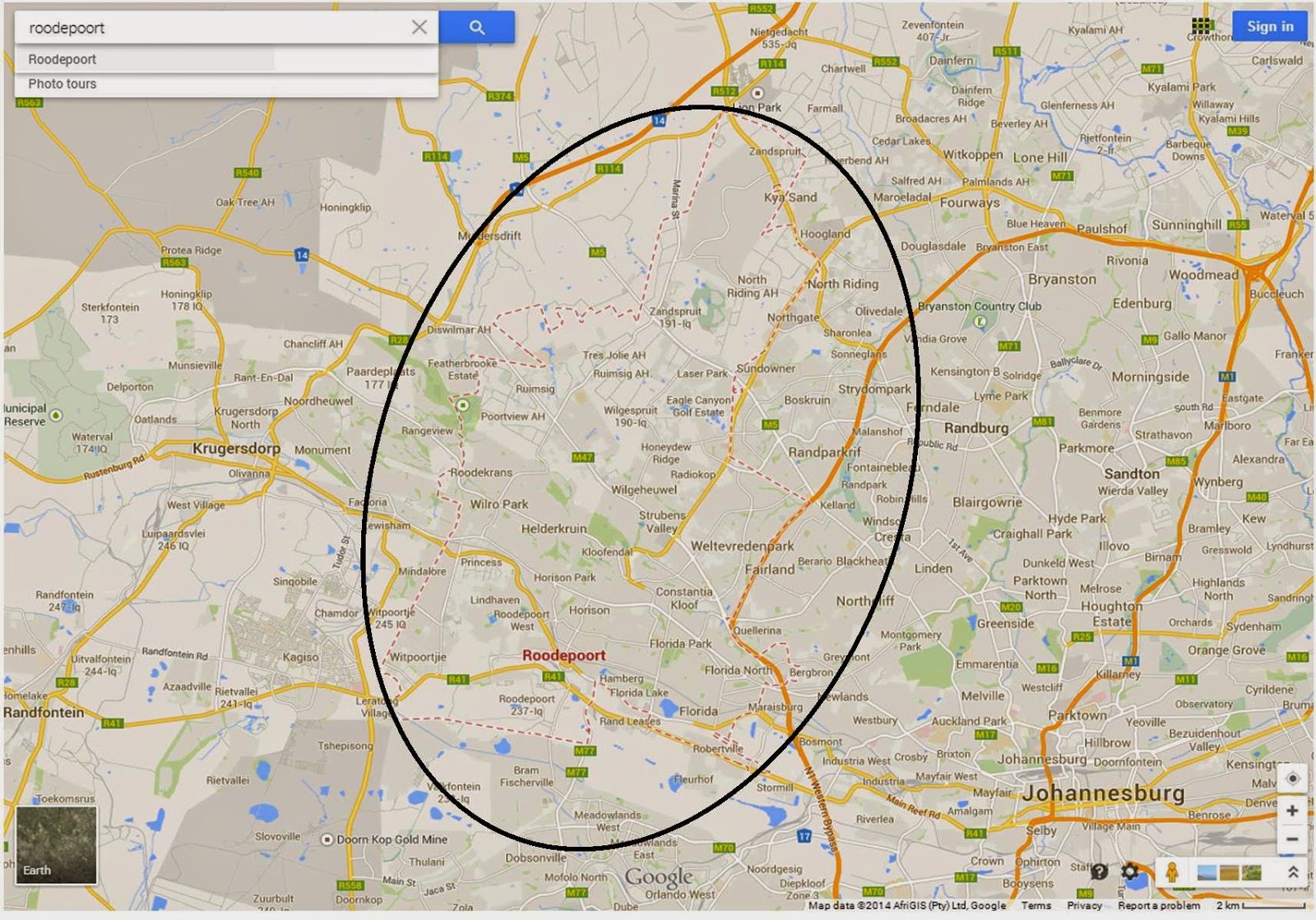
Alright so the table summarised the average of what is expected for the Johannesburg area, but my vegetable garden is in Roodepoort and we have a prominent hill that dictates locate weather patterns. Here is an overview of Roodepoort and that hill (of which I don't know the formal name, so let's make it Roodepoort Hill)...

Roodepoort Streetview Google map
Roodepoort topology Google map
Orange: Roodepoort Hill
Green: Water Sisulu National Botanical Gardens

Now, I don’t think that our Roodepoort Hill is large or high enough to cast a “rain shadow” on either side, but our rainfall patterns (time and amount) differs from Johannesburg and Pretoria. I mean rainfall even differs within Roodepoort itself. For instance, I have some rainfall data courtesy of a local golf estate not far from us and we have hugely different rainfall and temperature patterns! Let me summarise my observations similar to the previous table:

Highveld/Roodepoort Area Observed Seasonality
Season
Timeframe
Observed weather patterns
Spring
September to Late-October
I documented the last cold front in late Sep, hence the shift in seasonality, and there were some nasty cold August winds that did quite a bit of damage to early budding fruit trees. Maximum daytime temperatures only exceeded 20oC since Oct. First rains (above 5 mm event) arrived Mid-Oct.
Summer
Late-October to Mid-March
With the first rains came hail-storms, especially during Oct/Nov. On average <10 mm of rain fell during a rainfall event and more often a rain event would be 5-6 mm from Oct-Dec. From Jan-Mar rainfall occurred more often (average <15 mm) and 8-10 mm events would occur more often. The average maximum daytime temperature was 24oC, but several days reached 30oC during Nov-Jan. Average rainfall was 877.5 mm for the year, which is higher than average, but rain occurred mostly at night.
Autumn
Mid-March to Mid-May
March was still very hot and the average daytime temperatures only fell below 25oC during mid-march. Daytime temperatures remained around 20oC for most of Autumn.
Winter
Mid-May to August
Average daytime temperature was 16oC with the coldest days from June to August. Some very windy days did some damaged to plants in the garden. Two showers occurred, but the rain was so marginal it could not be measured. Light to severe frosts occurred during August and September.  

Final Remarks: Extreme weather dominated summer and we had several events when I was certain that the vegetable garden had its last day, these were:

1) Three hail-storms were recorded, two had 1 cm hail stones and the last had 4-7 cm hail stones!! 

I was convinced that the veg garden was flattened but thankfully we only had a few casualties.

Hailstorm, summer 2012-2013
Nasty serrated hail!
Hailstorm, summer 2013-2014
Hail stone in the picture on bottom right is one of those 7 cm ones!

2) Floods had occurred during January and February because of 100 mm rain falling within 24 hours, that is 10x more than our average rain event! You can see it on my rainfall graph as two huge spikes!

So much rain fell that several herbs had to be emergency evacuated into the house due to threat of dying! The Walter Sisulu National Botanical Garden not far from our home reported that flood waters had caused damage and resulted in a monster waterfall there!

Rain refugees

Waterfall at Water Sisulu NBG on the (left) during floods and on the (right) full, but normal size 
For more info and videos on the flood and waterfall of Walter Sisulu NBG check out:

Other observations:

1) Some interesting correlations was that it was more likely to rain when the measured humidity exceeded 60% and that I would not have to water the garden for a day only after 10 mm of rain had fell.

2) No bees are seen at the basil when rain is imminent.

3) Hailstorm clouds are big, black, high off the ground and scary. They mostly come from a South-Western direction, whereas thunderstorms are dark grey and big, but not so high off the ground. Yet they bring rain down with such a force that sometimes leads to damage.

4) A shift in maximum daytime temperatures. I measured weekly daytime temperatures during 11h00-13h00, as this is our 'official' maximum temperature during the day, but this has shifted to 15h00-17h00. Although, my average daytime maximum is at 24oC on my graphs, we regularly had temperatures of 29-31oC in the late afternoon!


Just a quick note on frost dates for Roodepoort, but I imagine it would be similar for the rest of the highveld (Johannesburg, Pretoria and Gauteng). The first date of expected occasional frost is 3 May, whereas the first expected date of regular frost is 30 May. Thereafter the last date of expected regular frost is 25 August, but the last expected date of occasional frost extends until end September (30 Sep).

I have expanded my weather observations to forecasting by using the shape and colour of clouds (still trying to get the hang of it, will do a full post of weather forecasting using clouds at a later stage!) and I am also recording all the activity in the garden in terms of wildlife as well – be on the lookout of a Nature Watch post later in the year! 

That concludes our crazy weather for 2013/14, stay tuned for another update next year! 

*Serious reporting voice*
…Keep well and good night…

______________________________________________________________________________

Please share with fellow gardening enthusiasts via the various sharing buttons at the end of posts/pages! Else you can vote for posts through the Google reactions bar at the end of articles. To stay up to date I have provided several reader and social networking platforms with which to subscribe: Twitter, Pinterest, RSS Feed Reader or Email/Follow directly using the Blog Followers widget on the left hand side toolbar. Thank you for reading and please feel free to ask if questions arise - I appreciate comments and ideas too! ðŸ˜†
_________________________________________________________________________________

Absolutely Gorgeous Beautique

Absolutely Gorgeous Beautique
Your beauty, weight loss, slimming and skin care salon of choice! Products with International Shipping!