Roots 'n' Shoots

Why is RnS Moving to whiskerflowers.wordpress.com?

Google had brought out an algorithm update in May 2017. With previous updates like Panda or Penguin, Mr G had penalized blogs or websites with low quality content and those more focused on aggressive adverts (including multiple ads or pop-up ads in articles). However, many blogs/websites that weren't shady got penalized beyond recovery too and a lot of people lost their income. The May 2017 update has had wide-scale effect on blogs and websites, but without any explanation from Mr G as to why or what it does. RnS has been hit by it too and hard. RnS organic search stats (i.e. users from Google) have dropped by 75% since. Even though RnS is not a source of income, I tried to figure out why RnS is being culled. It seems that it doesn't really have anything to do with RnS per se, but likely because RnS is FREE and not paying for page ranking (via AdWords or Ad Ranking). Now it is likely being aggressively shoved to lower page rankings to accommodate the paid ads.

I cannot rely on Mr G anymore to get RnS' content where it is needed. So I am busy moving RnS to Wordpress where you can find me as Whisker Flowers @ https://whiskerflowers.wordpress.com/

I am also imposing 301 redirects from already moved posts and pages!

- The Shroom - (AKA Whisker Flowers)

Wednesday, 18 January 2012

Praying Mantis: Biological Control - Garden Critter of the Month

 Mantids at a glance

Occupation:
Predator
Value to Gardener:
5/5 - Pest Controller!
Danger to Humans:
0/5 - None
Availability:
5/5 – They’ll arrive or you can buy some


Praying mantis eating blowfly

Quick Intro

Mantids are usually large, robust insects with mobile heads and large eyes. Mantids are visual predators that ambush prey with serrated forelimbs. I will be discussing the quintessential giant or common green mantid.

Science Stuff

The giant or common green mantid (Sphodromantis gastrica) belongs to the Mantodea order, Mantidea family. These include other common and stick mantids, which are green to brown, but not the beautiful floral mimics (Hymenopodidae family).

Common Green Mantid, Giant Mantid
(Sphodromantis gastrica)
Habitat

The giant mantid is found throughout South Africa and parts of Africa. They prefer dense foliage cover, such as bushes and trees, where they are camouflaged and await unsuspecting prey. They are common in domestic gardens and undisturbed vegetation. Provide shelter and hunting space in your garden by planting herbs that grow into substantial bushes, such as, Basil, Lavender, Mint and Rosemary. If you are able to purchase praying mantids, the giant ‘African’ (Sphodromantis gastrica) mantid is a huge favourite amongst collectors and insect enthusiasts and will be easy to find. (You can also buy some reallllly exotic ones also J).

Basic Praying Mantis Morphology
Mantodea


Diet

Praying mantids eat anything they can manage, but giant mantids prefer caterpillars (I think mine are at a loss when it comes to caterpillars, so they settle for aphids and beetles mostly J). I have observed mine eating all pest species (aphids, white fly…) and other not-so-problematic insects, such as stink bugs.

Munching a Stinkbug!
Giant Mantid, Common Green Mantid
Sphodromantis gastrica


Another Mantid Tip

When pruning herbs, shrubs or trees that are known mantid hideouts – keep an eye out for them and simply relocate them until the pruning ‘danger’ is over J. Or when pulling out carrots and beets, be sure to check the foliage, they are sometimes in there too!

Spent mantis egg case


Now for some interesting Evolutionary stuff on mantids (being a geneticist J)

Mantids can hear in the ultrasound spectrum (usually higher than 20 000Hz, which is the maximum point at which we can hear). This was first thought to have arisen to hear bats, but phylogenetic (genetic relatedness studies amongst mantid species, living and extinct) has shown that this ultrasound hearing capacity evolved before bats (bats evolved around 63 Mya and the ultrasound hearing evolved around 120 Mya).

Two ‘ears’ or proper insect term for ear, two sets of tympanums are located on the bottom of the thorax between the legs, one at the second and third pair of legs. Mantids respond to ultrasound only in flight, with the males being more responsive than females, as females are reluctant fliers and have reduced hearing.

Stick Mantid
Hoplocorpha species

Earlessness is considered to be the primitive or original state of the mantid and that hearing is a characteristic of more ‘newly’ evolved mantids species (newly being a relative term in evolutionary standards J). Some earless species do still exists and some mantids have lost their hearing ability, which is mostly linked to flightless females.

Now the reason to hearing matids. The cricket ear (located in the foreleg), evolved 200Mya and is primarily used for communication. Matids could have used their ears for intraspecific communication (mantids belonging to the same species would communicate differently) or prey location, but this was modified when bats evolved to avoid becoming dinner for echo-locating bats. Some birds also hunt in the ultrasound spectrum and wing movement produces ultrasound. So hearing could be an all round predator avoidance mechanism. But, this is all ‘educated/informative’ speculation and the true function of the mantid ear remains a puzzle.

This summary was compiled from the following research article:
D. D. Yager and G. J. Svenson, Biological Journal of the Linnean Society, 2008, 94: 541–568.


Fun Mantid Stuff

Whilst researching I came upon an origami mantid – so if you are bored fold a praying mantis and stick it in your garden. Who knows it might just scare the aphids away! JJJ

Origami Mantid

______________________________________________________________________________

Please share with fellow gardening enthusiasts via the various sharing buttons at the end of posts/pages! Else you can vote for posts through the Google reactions bar at the end of articles. To stay up to date I have provided several reader and social networking platforms with which to subscribe: Twitter, Pinterest, RSS Feed Reader or Email/Follow directly using the Blog Followers widget on the left hand side toolbar. Thank you for reading and please feel free to ask if questions arise - I appreciate comments and ideas too! ðŸ˜†
_________________________________________________________________________________

Wednesday, 11 January 2012

Basil: How To Grow - Herb of the Month

Basil stats/requirements at a glance

Ease of Raising:
2/5 – Very Easy, weekly check-ups
Water:
4/5 – A good amount (daily, especially in a container)
Sun:
3-5/5 – Full sun (can be grown in dappled shade)
Training:
5/5 – Absolutely, prune regularly to shape
Fertilise/Feeding:
1/5 – Minimal (at least in the growing season)
Time to Harvest:
1/5 – Immediate (purchased a seedling) to Soon (from seed)
Frost Hardiness:
2/4 – Mildly Hardy (can’t take severe frost)


Uses:
4/4 – Culinary, Medicinal, Pollinator attractor & Predator sheltering
Most Problematic Nemesis:
None
Container Plant:
Yes (preferably grown in the garden rather than container)

Basilicon or Ocimum
Elizabeth Blackwell
Quick intro

Up for discussion is Basil. Similarly to tomatoes, basil is a culinary force. Known as the ‘king of the herbs’ its uses and benefits are endless. Basil has been crossbred to produce and array of flavours, such as lemon, mint and even chocolate! Basil is a mostly non-fuss plant, but requires a large amount of water and needs to be pruned (not unless you want a monster plant J)


History

The basil herb has its origins in the Middle East (or India). Since ancient times it has been used by the Greeks, Romans and people of the Middle East. No other herb rivals the uses of basil for seasoning of meats, soups, sauces, pasta, breads, salads, and is also used in liqueur (chartreuse).  Its medicinal properties includes, a food digestion aid and the juice from its leaves apparently repel mosquitoes when rubbed on the skin.

Sweet Basil Leaf
(Ocimum basilicum)

Science Stuff

Sweet Basil, Ocimum basilicum, belongs to a large family of aromatic and culinary herbs, the Lamiaceae Family. This family includes most of the other well-known herbs, such as, rosemary, thyme, mint, oregano, savory, lemon balm, sage and marjoram.

The flavour and aromas of modern basil (lemon, mint …) are bred into the basil by crossbreeding with other members of the Lamiaceae Family and/or ‘fixed’ in the plant due to selective breeding for a certain flavour or aroma.


Growing Basil

Basil is easily raised from seed, although harvest would have to wait until the plant is a bit larger. Full sun basil does not succumb to any pest, but is not frost hardy and therefore is grown as an annual where frost is a problem.

Basil plants have distinctive round leaves with a mild basil flavour. After a year of growing the basil has essentially ‘matured’. The leaves lose their round shape and become straight. Their flavour increases by threefold! Also they start to flower prolifically. I do not believe it is necessary to cut the flowers for increased leaf growth, since happy basil produces 2L of leaves every two weeks in summer (with regular pruning J)

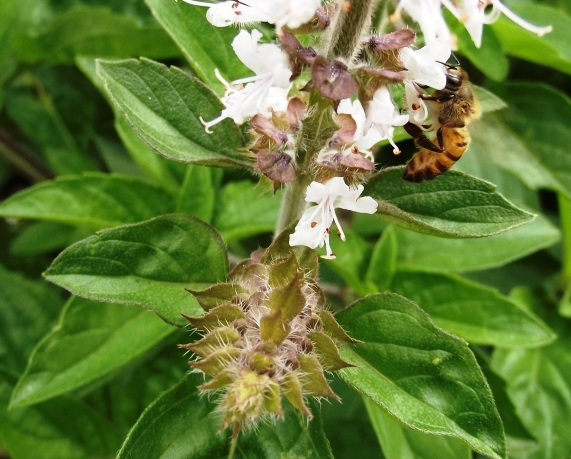
Pollinators: Basil flowers are excellent pollinator attractors. Mine has flying visitors throughout the day, zealously packing their legs with the crayon-orange pollen. Reliable visitors and pollinators for your other plants (especially fruiting plants) include insects from the following Families:

Collectidae – The solitary membrane bees

Membrane bees,
Collectidae

Apidae – The honey bees


Honey Bee
(Apis mellifera)
Anthophoridae – The bumble, masonry and carpenter bees

Bombyliidae – The hover, woolly bee and mimic bee flies

Woolly BeeFly
(Bombyliidae, Systoechus sp.)

I am sure butterflies will also make their rounds at your basil, but we have never had a large butterfly population in our area. Although honey bees are the best known pollinator, woolly beeflies and bumble bees are also essential (bumble bees are superior pollinators to honey bees, but they cover a smaller area).

Now then, to the Predators: A large basil bush (30cm-1m) will house an array of beneficial predators. These include:

Mantidae – The preying mantids

Common Green Mantid, Giant Mantid
(Sphodromantis gastrica)

Arachnida Class – these are spiders of all sorts (not insects, but arthropods). The spiders housed in the basil will likely be non-poisonous, such as, crab spiders, jumping spiders and even tiny web spinning spiders as big as a pinhead.


Honey Bee (Apis mellifera) caught
by Pink Crab Spider (Thomisidae)

Predatory Beetles – some click beetles, beetle larvae (predatory lady bug larvae)

Nemopteridae – The lacewings (predatory larvae and some adults are predatory)

These predators are excellent garden helpers and assist with Pest control. In South Africa there isn’t commercially available beneficial insects to buy (overseas you can buy yourself a supply of lacewings, ladybugs, mantids even parasitic wasps/mites to control pests). So here, we are stuck on getting them ourselves. I was fortunate enough to have a mantid female lay her egg sac on one of my plant stakes. Now I have a tireless patrol of ~12 mantids throughout the garden (6-7 live in the basil).

The predators use the basil as their home base, and will move between plants, eating pests as they go. Pests readily consumed include, aphids, whitefly, stinkbugs, leafhoppers, spittle beetles, scale bugs, caterpillars and anything else that eats your plants will be annihilated!


Pruning

The basil must be pruned to keep it bushy and under control, else it will smother other plants by growing over them and stealing sunlight J

The basil is a very forgiving plant when it comes to pruning. Decide on the high you would prefer your basil to be, such as 50cm. Then prune back (simply cut back each and every branch) 10cm under your preferable size (40cm in this case). This allows space for fresh, young basil leaves to grow and, with constant pruning, allows a continuous harvest of only the most tender basil leaves J

If you are interested in attracting pollinators, leave the basil to flower and then prune it in sections. I do mine in half. About every month, I chop down half of the plant and allow the other half to finish flowering. By the time the chopped have is flowering, the older (already flowered) half can be cut back again. P.S – when pruning, watch out for your garden helpers! Simply relocate them to the non-pruned part of the plant J

If your basil plant goes beyond 1m in height – I would recommend staking it for support – as the accumulated weight of the leaves and critters might cause it to become uprooted in a heavy downpour due to the additional weight of the raindrops. Or, you can have two basils going – one is pruned and kept under control for leaf harvesting and the other is staked, in a container and allowed to go crazy. This will ensure cooking supplies and garden helpers. Be sure to have the unregulated basil close to the vegetable garden to benefit from the insects it attracts and only prune it in autumn after flowering (so that it doesn’t go scraggly).


Other Basil Tips

When pruning, you will have a mound of basil leaves – to many to use. Either give these to the earthworms or use directly/as dried kitchen-waste compost for the garden. Leave some leaves J on the ground at the base of the plant – this houses a colony of decomposers, especially wood lice. In that way the basil provides its own fertiliser J


Harvesting & Storing

Basil leaves can be harvested when required. Branches with leaves can be stored in a glass of water for about a week. Else remove the leaves, vacuum pack (with a few drops of water on the leaves) and store in the fridge for 2-4 weeks (maybe even longer). Since you have a constant supply of leaves, you can always give surplus away to grateful friends J Drying basil is a snap, especially if you want a milder basil taste when cooking. Simply spread the basil leaves on a small towel and leave to dry on a table inside the house (2-3 days in summer). Store the dried basil in glass jars to preserve the flavour.


Seed Saving & Propagation

Basil seeds are ready for saving once the flowers have turned brown. The seeds are labelled and stored in a glass jar.

Basil is the easiest plant to propagate. Snip some branches off (10-15cm) and place in a glass with water. 2-3 weeks later small roots will appear. Leave the roots to become ~5cm long and plant in a pot. Keep the pot fairly moist until the basil plant has established itself.

Sweet Basil rooting
(Ocimum basilicum)

My Basils

Sweet Basil: This is my big monstrosity! It was already 4 years old (container bound) when I transplanted it into the garden – it has been ill-disciplined ever since J. It managed to uproot itself just the other day during a typical Highveld thundershower that lasted 20min. I wanted to cut it down for some time now, so that was the perfect opportunity – shoots re-emerged after two weeks. I moved all the flowers to a large bucket with water, so that the bees still had some food, and relocated garden critters to other parts of the garden.


Sweet Basil
(Ocimum basilicum)

Lemon Basil: Great for adding ‘lemon’ flavour to dishes without adding any lemony sourness.

Lemon basil
(Ocimum sp.)

Mint Basil: Mild mint taste, useful in salads, soups and sauces.


Mint basil
(Ocimum sp.)

Thai Siam Queen Basil: Slight anise flavour and deep pink flowers. Essential for Indian & Chinese cooking! It did poorly in its first season, but managed to survive and is coming around nicely now.


Thai Siam Queen Basil
(Ocimum sp.)


______________________________________________________________________________

Please share with fellow gardening enthusiasts via the various sharing buttons at the end of posts/pages! Else you can vote for posts through the Google reactions bar at the end of articles. To stay up to date I have provided several reader and social networking platforms with which to subscribe: Twitter, Pinterest, RSS Feed Reader or Email/Follow directly using the Blog Followers widget on the left hand side toolbar. Thank you for reading and please feel free to ask if questions arise - I appreciate comments and ideas too! ðŸ˜†
_________________________________________________________________________________

Thursday, 5 January 2012

Breaking News: Honey Bee - Colony Collapse Disorder

A parasitic fly and accompanying pathogens may be one of the causes of Colony Collapse Disorder (CCD).

Proffessor John Hafernik observed a fly that parasitizes and kills honey bees. This accidental discovery lead to research by Andrew Core and other researchers, from the Biochemistry and Biophysics Department of the University of California, to investigate the impact of such a parasite on honey bee colonies.

The honey bee is infected by the phorid fly, Apocephalus borealis, also known as the ‘decapitating fly’. The female oviposits (lays eggs) within the honey bees’ abdomen. The honey bees become disoriented, abandons the hive and eventually dies as the fly larvae hatch and develop within the bee. The fly larvae emerge from the dead bee to pupate. Up to 13 mature larvae can emerge from a single honey bee, increasing the parasite population rapidly after each successful infection. The entire process of infection to emergence of adult flies takes about 2 months.

The fly is a vector or reservoir of several debilitating honey bee pathogens, such as, Deformed Wing Virus and Nosema ceranae, another micro-parasite. The cumulative effect of the parasitic fly, pathogens and other environmental factors may be responsible for CCD observed worldwide.

This leads us a step closer to solving the CCD mystery and hopefully a cure before we are left with no honey bees to save.
Decapitating parasitic fly - Apocepahlus borealis
Wikipedia
A New Threat to Honey Bees, the Parasitic Phorid Fly Apocephalus borealis.
Core A, Runckel C, Ivers J, Quock C, Siapno T, et al. (2012).
PLoS ONE 7(1): e29639. Doi:10.1371/journal.pone.0029639
 

The Scientific Article

Core A, Runckel C, Ivers J, Quock C, Siapno T, et al. (2012).
PLoS ONE 7(1): e29639. Doi:10.1371/journal.pone.0029639  

Related Scientific Articles
Runckel C, Flenniken ML, Engel JC, Ruby JG, Ganem D, et al. (2011)
PLoS ONE 6(6): e20656. doi:10.1371/journal.pone.0020656 


Online Popular Articles


The Vancouver Sun


Update: 18 Oct 2013 - Bee Colony Failures and the SLS model

______________________________________________________________________________

Please share with fellow gardening enthusiasts via the various sharing buttons at the end of posts/pages! Else you can vote for posts through the Google reactions bar at the end of articles. To stay up to date I have provided several reader and social networking platforms with which to subscribe: Twitter, Pinterest, RSS Feed Reader or Email/Follow directly using the Blog Followers widget on the left hand side toolbar. Thank you for reading and please feel free to ask if questions arise - I appreciate comments and ideas too! ðŸ˜†
_________________________________________________________________________________
Thursday, 29 December 2011

Tomato: How To Grow - Fruit of the Month

Tomato stats/requirements at a glance

Ease of Raising:
2/5       - Weekly check up
Water:
5/5       - A lot (daily to twice daily especially, during fruit set)
Sun:
5/5       - Full sun, no shade (fruit ripening)
Training:
5/5       – Full stake training to fruit properly
Fertilise/Feeding:
3/5       – Monthly (growing) to Fornightly (fruiting)
Time to Harvest:
2-5/5    – Moderate (2-3 months after fruiting, given training)
Frost Hardiness:
1/4       – Very Tender (can’t take light frost)


Uses
Culinary, Pollinator attractor
Most Problematic Nemesis:
Whitefly
Container Plant:
Preferable


Tomato species
Lycopersicon
Quick intro

Tomatoes are the most well-known and widely used culinary fruit (a botanical fruit, used as a culinary vegetable). They are fairly easy to grow, maintain and carry a good amount of fruit. The largest problem with the tomato is its thirsty habit and those diabolical whiteflies love it.


History

Tomato has it origin in South America and is considered to be domesticated, from once poisonous varieties, in Mexico. It was spread into Europe by Spanish traders during the 1600. It became popular in America towards the late 1800, introduced through Europe. No other fruit, except perhaps for the Cucurbits, contains such a variety of cultivars with every shape, taste and colour imaginable. This has been established through selective breeding by farmers, gardeners and researcher alike – we constantly have new varieties popping up, not only beneficial for us to sample, but increases the overall genetic diversity of the tomato genus (yes! GMOs especially, increase biodiversity).


Science Stuff

The tomato belongs to the Solanaceae Family, which includes potato, eggplant, peppers and nightshade! The standard tomato, Lycopersicon esculentum, is thought to have evolved from the cherry tomato, Lycopersicon esculentum var. cerasiforme, through selective breeding for size and taste.

Tomatoes contain Tomatine, which is a non-toxic alkaloid, exceptional for the Solanaceae Family. Tomatine content reduces as the tomato ripens and becomes sweeter, as alkaloids are usually bitter-tasting.

Green Tomato with Tomatine


Growing Tomatoes

Tomatoes can be easily raised from seeds or seedlings can be purchased. Sow tomato seeds outdoors as soon as the last frost is gone (usually August for SA), if the seeds fail to germinate it is an indication that the soil isn’t warm enough yet. Thus, trick you seeds into germinating by sowing into pots indoors and letting them become established on a warm, sunny windowsill. The seedling can be planted out as soon as the first set of ‘true leaves’ appear. For all my plants I make a 1-2cm hole in the ground, place the seed in and sprinkle with fine soil to fill the hole – this prevents seedling from being washed out and increases seed germination for my plants.

Tomato Seedling

Tomatoes are indeterminate (grow until the onset of frost or last fruit set) or determinate (grow to a fixed height). I would recommend training both varieties.

The number of tomatoes you grow depends (1) on the garden space and (2) how much you eat, but as a guide I plant two tomatoes of a variety (such as, two standard sized and one/two cherries). These are planted one in a pot so that you have maximum control over their growth, feeding and watering. Before sowing in a pot, dig a 20cm hole, add some kitchen waste and sprinkle a little granulated fertiliser. This allows the seedling to grow and access the nutrients without burning, check out Composting. After sowing add a stake near the sowing spot for plant support. Plant one seed every month for succession harvesting of tomatoes, given training!

Tomatoes like a lot of sun, mine grow in the full African sun, where they receive 6-8 hours of full sunlight. The warmth and sunlight is also important for fruit set and ripening.


Training

Training is very important for tomatoes! This means plant support with stakes, lots of them! I let the tomato grow 3 main branches, originating as close to the ground as possible (for extra support). The main branches then split into 2-3 shorter branches close to the full height of the plant. Then, each main branch is allowed to carry 5-7 tomatoes (standard size tomatoes) or 4-6 trusses (cherry tomato, 7-10 fruit per truss). This gives you 15-20 tomatoes per standard and 40-60 per cherry. (Times two, for two plants, are more than enough tomatoes! J).

Here are some illustrations:
These are a rough and simplified guide, just to get you started on training the plant. Training and a little pruning is essential to early ripening for tomatoes after one month of fruit set. Untrained plants grow erratic; produce too many tomatoes that do not ripen and the few that do ripen only do so in 3-4 months after fruit set!! (That is February for SA). Training, along with succession planting and replacing already harvested plants, allows a continuous supply of tomatoes. Other plants can also be trained in this manner, such as eggplants and peppers. (When tying the plants to the stakes, leave 1-2cm of space between the plant stem and the stake – it still secures the plant without damaging it.)


Other Tomato Tips

Tomatoes can be wind pollinated, but insect pollination is best – so make sure to have some bees around for this (plant some basil J). When the flower has been pollinated and is dying, be sure to remove all the petals (yellow coloured leaves) and style (the long appendage attached to the developing fruit). This ensures proper fruit development as I have noticed that sometimes these structures do not detach and then ‘pull’ over the developing fruit, scarring the fruit. Do not tug on the dead flower, if it does not come off easily, leave it for one/two more days – else you rip out the developing fruit J.


Tomato Flower


Make sure that the containers you grow them in always have water in the saucer.

I feed the tomatoes Starke Ayres Nutrifeed (monthly and fortnightly) and the Cultura 2:3:2 granulated fertiliser (sprinkled every month), see Composting.


Tomato Problems

The biggest problem is the regular visit from whiteflies, which left unchecked become a large cloud of white when disturbed. Use my environmentally friendly whitefly recipe for Pest Control.

Another problem, which I mainly have with the Brandywine, is that the fruit cracks whilst ripening. This is due to the heat and does not affect the tomato.

Cracked Tomato


If birds peck at your ripe tomatoes, put a little gnome or human-like figurine in plain sight. This should scare them off! Else try windmills or shiny objects, described in my Pest Control page.


Mr. Garden Gnome on the watch! Atop the tomato stake.


Harvesting & Storing

Tomatoes are ready to harvest once they are full coloured and slightly soft when poked. They can be left on the vine until ready to eat or pick them when ripe and place them on a counter at room temperature (they’ll keep for about 3-5 days). For fridge storage, put them in a bag or sealable container with a few drops of water to prevent them from shrivelling in the dry fridge.


Seed Saving

If you would like to save the seeds of your tomatoes – simply leave one/two small tomatoes to die with the plant, after the plant has died remove the tomato and leave to rot. Wash and collect seeds afterwards. The seeds require the fermentation process to become robust and viable. Dry the seeds on a towel in a dry area for 2 days and store in glass jars/containers with a label, photo and a description of the tomato.


My Tomatoes

I have Starke Ayres tomato seeds:

Money Maker: A red standard. This is a very good producer and is somewhat heat resistant.
Gold Nugget: A yellow cherry. Loves the African sun J - not so heavy on water.

And imported seeds from ebay:

Brandywine: I have a rainbow seed packet. This season produced a ‘golden’ tomato, sweeter and finer taste than the common tomato – I do not like tomatoes, but this one I managed to eat J


Brandywine Tomatoes


Pineapple: The pineapple tomato simply did not cope with the African heat. I am going to try to plant it elsewhere and see whether I can get some pineapple tomatoes out of it J.

______________________________________________________________________________

Please share with fellow gardening enthusiasts via the various sharing buttons at the end of posts/pages! Else you can vote for posts through the Google reactions bar at the end of articles. To stay up to date I have provided several reader and social networking platforms with which to subscribe: Twitter, Pinterest, RSS Feed Reader or Email/Follow directly using the Blog Followers widget on the left hand side toolbar. Thank you for reading and please feel free to ask if questions arise - I appreciate comments and ideas too! ðŸ˜†
_________________________________________________________________________________

Absolutely Gorgeous Beautique

Absolutely Gorgeous Beautique
Your beauty, weight loss, slimming and skin care salon of choice! Products with International Shipping!